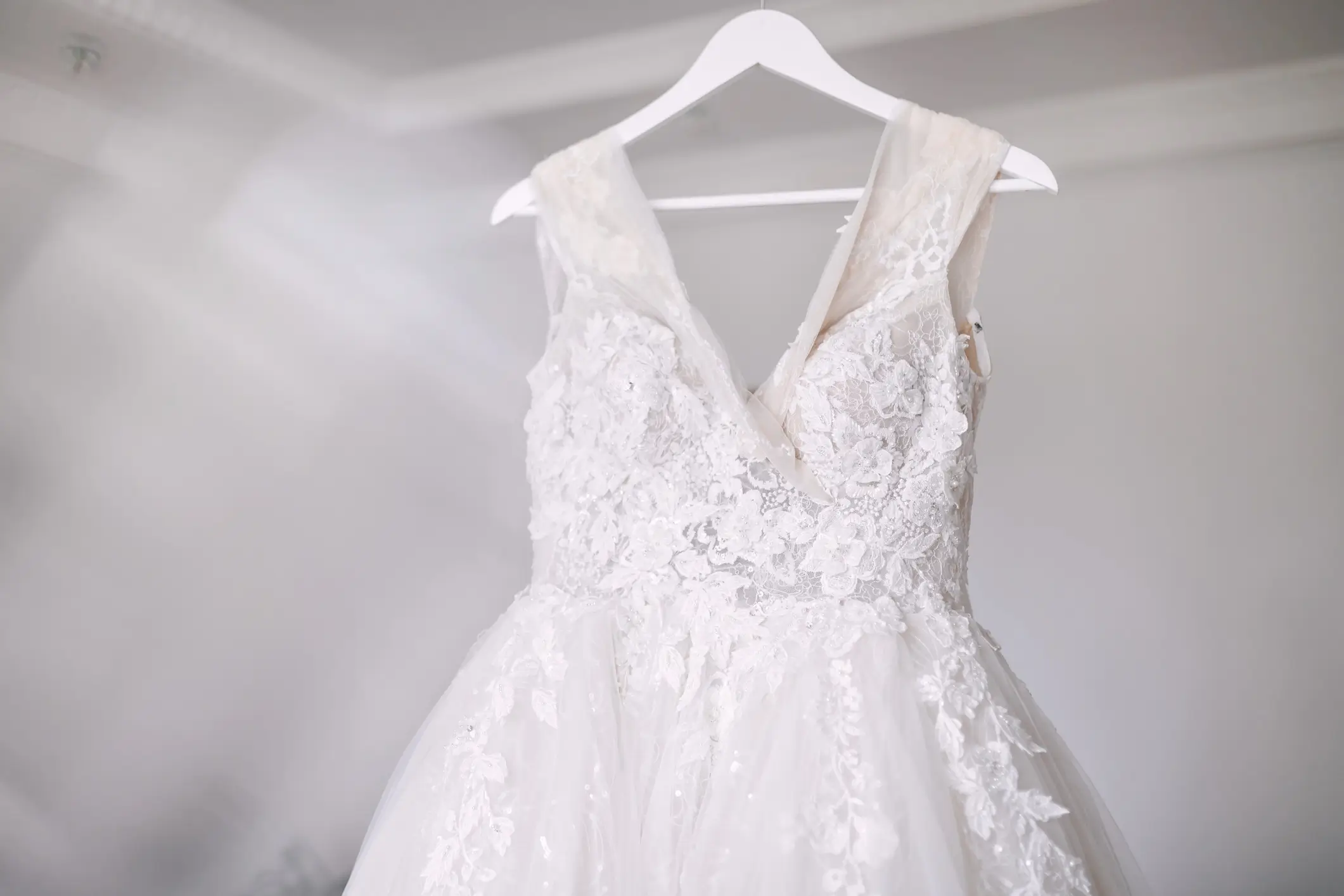
A wedding dress can look perfectly white today and still be vulnerable to yellowing over time. The change isn’t simply a matter of age. Invisible stains, lingering residues, light exposure, and improper storage materials can all contribute to discoloration, sometimes long before there’s anything noticeable on the fabric.
Understanding these factors matters whether your dress has already begun to yellow or you’re preparing to store it for the first time. Knowing what can contribute to discoloration helps you make better decisions about cleaning, storage, and wedding dress preservation for the years ahead.
Here’s what can quietly contribute to yellowing and why addressing it early matters.
Champagne, sugar, perfume, and body oil can soak into fabric without leaving a visible mark on the wedding day itself. None of these substances is yellow when they land on the dress. They become yellow later, as the sugars and oils oxidize and interact with the fibers over time.
This is the slow-oxidation part most brides don't expect. A dress can leave the cleaner looking flawless and still develop faint yellow patches months or years later, as invisible residues slowly oxidize. That delay is why so many brides mistake it for simple aging, when it's really a reaction that started on the wedding day and just took time to surface.
Direct sunlight isn't required to damage a wedding dress. Ordinary light, including the ambient light that comes through a closet door left ajar or that filters in through a bedroom window, triggers a slow chemical process in the fabric called photo-oxidation. Over months and years, this breaks down fibers at the molecular level and produces the same yellow tint associated with age.
Light damage is cumulative, and it doesn't reverse itself. A dress that never sat in direct sun can still yellow from years of low-level exposure, because every bit of light the fabric absorbs adds to the total. This is why a truly protective storage plan accounts for ambient light, not just obvious sources such as an open window.
Standard cardboard boxes and regular tissue paper are common causes of yellowing, and this has nothing to do with anything that happened at the wedding. Ordinary paper products contain lignin, a naturally occurring compound that turns acidic as it breaks down. That acid transfers directly into the fabric it touches, and it will discolor a dress even if the dress was cleaned perfectly beforehand.
If your dress has been sitting in a standard box since the wedding, it's worth having it checked before the packaging does more damage.
Not all "acid-free" materials are equal. True acid-free tissue has the lignin fully removed, while acid-neutral tissue still contains lignin that can turn acidic again over time. Silk needs unbuffered, acid-free materials specifically, since buffering agents made for cotton and linen can damage it. True archival materials protect against this cause entirely.
Attics, garages, and basements without climate control put a dress through repeated stress. As temperature and humidity rise and fall, fabric fibers expand and contract, and the chemical reactions that cause yellowing speed up. A dress stored in a stable, moderate environment ages far more slowly than one exposed to seasonal extremes, including:
Humidity does more than speed up yellowing. Repeated swings between damp and dry conditions create an environment where mold and mildew can take hold, which introduces a second type of discoloration entirely separate from oxidation. A dress can develop yellowing from chemical breakdown and staining from moisture at the same time, which is why humidity control matters as much as temperature control.
Seeing yellowing on a dress you've already stored doesn't mean the damage is permanent, and it doesn't mean you did something wrong. The causes above explain what happened. What matters now is finding out how far the discoloration has progressed and whether or not it's still treatable, which isn't something you can judge accurately just by looking at it.
A proper assessment looks at the type of discoloration, how deep it sits in the fibers, and which cause is most likely responsible, since residue-based yellowing, light damage, and acid transfer each respond differently to treatment. That's the information that determines if the yellowing can be reversed, minimized, or simply stopped from spreading further.
If your dress hasn't gone into storage yet, you're in the best possible position to prevent every cause on this list. Cleaning the dress before storage removes the invisible residues that would otherwise oxidize over time, and using archival materials protects it from acid transfer and stabilizes it against light and climate stress.
Clean first, then store. A dress packed away with residues still in the fibers will yellow eventually, even in the best archival box, because the box only controls what happens from that point forward. Professional preservation handles both steps together, so nothing gets missed between them.
Once the wedding is over, your dress deserves more than a temporary spot in the closet. The stains, oils, and other residues discussed above can become more noticeable over time, making professional cleaning and proper storage an important part of caring for a dress you may want to keep.
University Cleaners has decades of experience working with wedding dresses made with delicate lace, fine fabrics, intricate beading, and other special details. We carefully evaluate each dress before beginning the cleaning and preservation process, whether it has already started to show signs of yellowing or has been waiting since the wedding day for proper care.
If you’re in Shenandoah Valley and looking for Wedding Dress Cleaning and Preservation Service, take your dress to University Cleaners. Give the dress that holds so many memories the thoughtful care it needs for the years ahead.
Free Pickup and Delivery Service Available
Lexington: 534 E. Nelson St., Lexington, VA, 24450, United States | Phone: (540) 464-6900
Staunton:1007 N. Augusta St., Staunton, VA, 24401 | Phone: (540) 886-2795
Staunton: 729 Richmond Ave., Apt. D, Staunton, VA, 24401 | Phone: (540) 346-3158